How to Win on Customer Sustainability Requirements

A practical playbook for Directors of Sustainability and CSOs to turn questionnaires, procurement data requests, and ESG clauses into a prioritized roadmap for your competitive advantage.
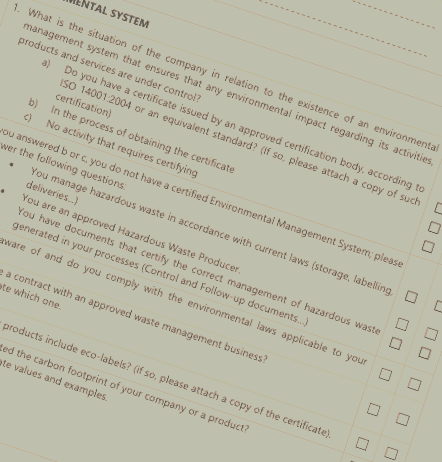
Customer sustainability requirements have quietly become one of the strongest forces shaping corporate sustainability programs. They show up as supplier codes of conduct, Request for Proposal (RFP) language, product-level carbon data requests, deforestation commitments, packaging standards, human rights due diligence expectations, and more. These asks are numerous, inconsistent, and often written in a way that makes perfect sense to a procurement team but requires translation into operations, legal, finance, and product decisions.
Why customer requirements deserve a dedicated strategy
For a Director of Sustainability or Chief Sustainability Officer, customer requirements are both a risk signal and a market indicator. They indicate where revenue could be lost in the form of failed onboarding, stalled orders, and disqualification from tenders. These customer requirements also show where value can be created by attaining preferred supplier status, winning price premiums, signing longer contracts, and opportunities for joint innovation. Treating each questionnaire as a one-off response wastes time and while not allowing your company to see the opportunities across your customer base. The benefits of a strategic approach include:
- Reduced sales friction: faster RFP responses, fewer redlines, fewer “come back when you have…” conversations.
- De-risking delivery: anticipate data, assurance, and audit requirements before they become contractual obligations.
- Focusing investment: fund the capabilities that matter most to customers while avoiding initiatives that don’t mater.
- Differentiation: package sustainability performance into sales enablement and product positioning.
How to research and understand customer sustainability requirements
If you only read the questionnaires and respond to each one individually, you may be missing out on learning more about your customers. By taking time to consider what your customers are asking for, why they are asking, and how they will use your response, you can learn key information that will add to your strategy. Consider these implementing a process that employs these tasks to ensure that you are proactively managing your responses while gathering the intel necessary to inform the corporate sustainability stategy:
- Voice-of-customer interviews: Partner with Sales/Account Management to interview 10–20 priority customers. Ask what triggers sustainability requests, how requirements are weighted, and what “good” looks like. Clarify what information might be needed from your key departments: procurement, sustainability, quality, engineering, legal.
- RFP/RFQ and supplier requests: Collect the last 12–18 months of sustainability sections from RFPs, supplier portals, and due diligence forms. Extract the questions into a structured library.
- Contract language and legal clauses: Work with Legal to identify sustainability clauses that are becoming standard: emissions reporting cadence, audit rights, traceability, restricted substances, responsible sourcing, modern slavery, data assurance, and incident notification.
- Customer public commitments: Map your top customers’ targets and policies including examples like net-zero timelines, SBTi alignment, deforestation-free sourcing, packaging commitments, and human rights due diligence. These will usually indicate what they will ask suppliers to do next.
- Industry and market signals: Look for sector-specific initiatives, rating schemes, and emerging norms. Often, a “nice-to-have” requirement becomes a requirement within 12–24 months.
- Your own performance and pain points: Review internal data to see which questions take the longest to answer, where you have weak evidence, and where your responses have triggered exceptions or escalations.
Translate procurement questions into actionable requirements
Many customer requests are proxies for deeper needs. A question like “Do you measure Scope 3?” may really mean: “Can you provide product carbon footprints with credible methodology, and can we rely on the data for our disclosures?” Before you prioritize, standardize each requirement into a common format:
Field | What to capture |
Requirement statement | Plain-language “shall” statement (e.g., “Provide verified annual Scope 1–2 emissions and intensity metrics”). |
Business driver | Screening, scoring, contracting, compliance, customer reporting, product claim, risk management. |
Evidence type | Policy, data table, calculation method, third-party assurance, audit report, traceability records. |
Owner(s) | Function accountable for delivery: EHS, Operations, Procurement, HR, Product, Finance, Legal, IT/data. |
Cadence | One-time, annual, quarterly, per-product, per-shipment. |
Dependencies | Supplier data, meters, ERP fields, LCA tooling, QA testing, certifications. |
A prioritization process that holds up in the C-suite
The sustainability function in a company adds value through assisting with the prioritization of these customer requests. Your company likely will not be able to satisfy every request so it will be best to focus on responding to those requirements that align with the corporate strategic plan while growing revenue and reducing risk. A practical approach is to run a quarterly (or biannual) prioritization cycle using a weighted scorecard and clear governance.
Step 1: Build a consolidated requirements backlog
Combine all customer asks into one backlog to use as your single source of truth. De-duplicate similar questions, standardize wording, and link each item to the customers and opportunities where it appears.
Step 2: Define scoring criteria
Use 5–7 criteria maximum so the model is easy to use. Here is a starting list of criteria that resonate with finance and commercial leaders:
- Revenue at stake: current revenue and near-term pipeline linked to the requirement.
- Customer coverage: number of strategic customers requesting it (and their market influence).
- Contractual/material risk: likelihood of audits, penalties, termination rights, or regulatory exposure via flow-down clauses.
- Strategic differentiation: potential to win deals, command a premium, or unlock a new segment.
- Feasibility: time, cost, and organizational change required to implement credibly.
- Data/assurance readiness: ability to provide defensible evidence (including third-party assurance where needed).
Step 3: Score, then calibrate with a cross-functional panel
Convene a small cross-functional panel led by sustainability staff. Include departments like Sales, Procurement, Operations, Legal, Finance, and Product/Data. Review the scores and resolve any outliers. Calibration is essential since it prevents teams from gaming the scorecard and ensures that hard but valuable items aren’t automatically deprioritized.
Step 4: Convert the top priorities into a funded roadmap
Turn your top 10–20 requirements into initiatives with owners, milestones, and budgets. Treat them like product features: define the minimum viable capability (MVC) needed to satisfy customers now, then the “version 2” enhancements that strengthen differentiation (e.g., moving from self-reported data to assured metrics).
A step-by-step plan to turn compliance into business advantage
- Align on a commercial objective: Define what winning means for your company. This could mean things like reducing RFP cycle time by 30%, protecting top-20 accounts, qualifying for a new customer segment, increasing sales for lower-carbon products. This keeps the program from becoming a reporting exercise.
- Setup a requirements intake and triage process: Create a simple front door (shared mailbox or form) and a weekly triage meeting. Classify each incoming ask as standard response, needs escalation, or requires new capability.
- Build reusable response assets: Develop a controlled library of approved answers, evidence, and data tables. This prevents Sales from reinventing responses and Sustainability being trapped in never ending spreadsheet creation.
- Fix the data at the source: For top priorities, map data lineage including system of record, calculations, and approvals. Automate where possible and define controls including versioning, review cadence, and sign-off. Having repeatable and reusable data will free your time and allow for focus on strategic sustainability priorities.
- Operationalize delivery: Translate requirements into standard operating procedures like supplier onboarding steps, product development gates, training, internal audit checks, and corrective action workflows.
- Package performance for go-to-market: Turn your strongest capabilities into customer-facing collateral: a one-page sustainability capability statement, product carbon data sheets where relevant, and a clear explanation of boundaries and methodology.
- Measure outcomes and refine: Track leading and lagging indicators (RFP response time, win rates in sustainability-weighted bids, number of escalations, audit findings, customer satisfaction with sustainability responses). Use results to refresh the roadmap each cycle.
How an outside consultant can accelerate implementation
Many sustainability leaders are asked to meet rising customer expectations without commensurate headcount, data infrastructure, or cross-functional capacity. A good external partner should reduce the burden on your team while strengthening internal ownership. Common ways consultants add value include:
- Rapid requirements mining: extracting and categorizing hundreds of RFP questions and contract clauses into a structured backlog.
- Benchmarking and foresight: bringing cross-industry patterns, what “good” looks like, and which requirements are likely to become mainstream next.
- Facilitated prioritization: designing the scorecard, running calibration workshops, and documenting decisions so tradeoffs are explicit and defensible.
- Data and controls design: mapping data lineage, designing calculation methodologies and governance, and preparing for assurance-ready processes.
- Program management capacity: establishing the overall process including intake, backlog, and roadmap reviews while keeping initiatives moving across functions.
- Customer-ready packaging: creating response playbooks, evidence packs, and sales enablement materials aligned to common buyer questions.
- Change management: training account teams and internal stakeholders so the process survives beyond the initial push.
Closing thought: treat customer requirements as a product
The organizations that win won’t be the ones with the best sustainability report. Instead, they will be the ones with the ability to meet customer expectations with credible evidence. By building a requirement intelligence system, translating customer asks into operational capabilities, and prioritizing with discipline, you can protect revenue today while prioritizing the sustainability capabilities that create tomorrow’s growth.
Subscribe to the Rising newsletter to get our latest thoughts.
Member discussion